Showing posts with label Tools. Show all posts

Thursday, August 30, 2012

The Cup

The sacred drinking vessel is an essential ritual tool in almost every spiritual practice. Entire mythologies have been written solely on the subject such as the Akshaya Pathram, the Holy Grail, the Cup of Jamsshid and the Cornucopia just to name a few. As a tool it is used in any ritual where drinking something is done, be it blood, wine, or some hallucinogenic lubricant. As mentioned in The Sacred Meal, the cup is used to hold the blessings of the divine and to return those blessings to them. 
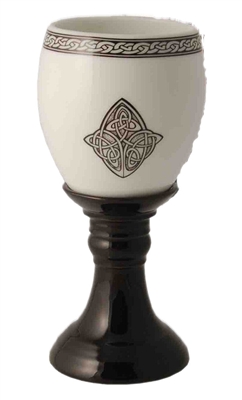
And of course, in Traditional Wicca there are certain ways that it should be made. As the Receptive Feminine Tool it should be made of feminine materials such as clay or stone. I thought glass would have been fine, but I was told that it was too common and too modern to have the desired effect.
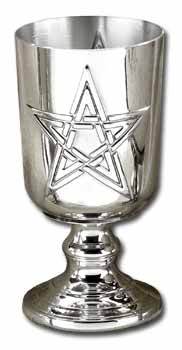
 Silver is an option, but it tarnishes and can have odd chemical reactions with certain things like salt. Furthermore, one must be certain that what you are drinking out of is actually silver instead of plated because other showy metals can be toxic - just ask the Tudors.
As far as the general look of things go there isn't anything expressly traditional. Wiccans call their cup a "chalice" for religious and ostentatious reasons and as such the overall expected look of the sacred cup is that of a stemmed bowl or goblet. Though Indiana Jones would have us believe that the Holy Grail is a simple wooden cup fit for a carpenter and his fishermen buddies, the religious expression of that has been anything but simple. 
Following in the footsteps of other sacred vessels like the Gunderstrup Cauldron or the Ardagh Chalice, most Pagans today like to have symbols of their faith on them. Depending on the tradition they may be simple or ornate, traditionally feminine like moons or symbolic of male deities like grapes.
Of course, there are those that take it too far...
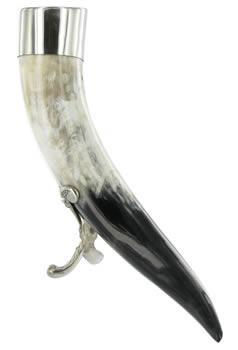
And not all Contemporary Pagans choose to drink from a cup as their sacred vessel. Anything that can hold liquid qualifies and drinking horns are fairly common among Northern European Traditions like the Asatru. I actually use a horn on my person shrine because the stoneware cup I had for years was finally retired by a cat that was too curious about its contents. They generally require a stand to be set down on a surface and this can add some decoration and permanency to the altar even while the vessel is in use. 
I would like to find or make a kylix eventually for my own uses. A kylix is a Classical Greek drinking vessel with a shallow bowl with two handles atop a stemmed base. They generally are decorated with images inside the bowl. The word kylix is the Greek root for the Latin calix that is in turn the root for the English chalice.

~A. Fox

Monday, June 4, 2012

The Sacred Meal

Sometimes called "Cakes and Wine" or "Cakes and Ale," the Sacred Meal is like the Contemporary Pagan version of the Eucharistic. Almost all religions have a sacred meal. Food is brought before the Divine and blessed then consumed. Sometimes the idea is that the god or spirit consumes the essence of the food and then replaces that essence with a blessing.
In Contemporary Paganism we use bread and wine most often, but this isn't always the case. I like to use mead instead of wine when I can. Some use fruits or grains like rice or oats instead of bread.
I learned this from Traditional Wicca, but other denominations have been inspired by other sources. In Traditional Wicca the meal is blessed just after the Divine has been brought down into the bodies of the High Priestess and her High Priest. These two figures bless the wine in a symbolic sexual act, bringing the athame down into the chalice that holds it. As a symbolic act of orgasm the wine is then asperged onto the bread or cakes that sit on top of the altar tile which locks in the blessing. The blessing is then returned in thanks to the gods through libation and then the cup and bread are passed around the coven to be consumed, each member making their own libation before consumption. Whatever works they have gathered for are then carried out with the blessings of the gods within them to empower the works.
In non-traditional Wicca  the sacred meal takes place at the end as an act of grounding out the energies raised during the ritual and libation is often not given.
I prefer to do the meal at the beginning of the ritual and meditate at the end to ground out any unwanted excess energy.
~A. Fox

Monday, May 28, 2012

Tile of the Earth

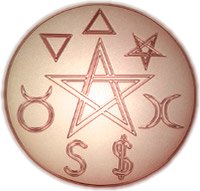
I've been working on crafting the Earth Tile for my shrine. Calling it an "Earth Tile" isn't the normal name. Before it was called anything else it was simply the Pentacle. A pentacle is an object with a pentagram drawn or carved on it. Traditional Wicca has a slew of other symbols that they include on their's depending on their degree of initiation. The triangles and smaller pentagram represent those degrees, the horned circle symbolizes the Divine Masculine and the back-to-back crescents symbolize the Divine Feminine and the two S's are symbols for "Mercy/Kiss" and "Severity/Scourge."
Like the blade, there are recommended materials to make the Pentacle or Tile out of. Of all the tools, this one is deviated on the most in both substance and in image. It's supposed to be made of a masculine material. Though this is generally a metal such a bronze or better-yet gold the Pentacle is most often made of copper, which is the metal associated with Venus, and hence a feminine material. A masculine wood would work and the most common of those is Oak.
Eclectic (or non-traditional) Wiccans and other NeoPagans deviate on every aspect of the tradition standards of the altar tile, incorporating other symbols, leaving it at just a star (and not always a five-pointed one) in a circle or some other shape or changing the focal symbol all together. These variant tiles have been made in every conceivable material and I've even know temporary ones to be drawn out on paper. The fun part about all these variations is that most of them do not take into consideration exactly what the altar tile is for.
As the tool for the element of Earth the tile is to center and ground or lock energies into place. So, at the end of any ritual in which the practitioner has charged an object with magical or psychic or divine or whatever sort of energy they place it on the tile to lock it into place. When it comes time for the Sacred Meal this tool takes on an even more specific role: the role of the Sacred Serving Plate. The tile becomes either a platter or the base of another platter upon which the cakes at set. 
This last image is what I've decided to put on my altar tile. As a symbol and tool of the element of Earth goes, this one is fairly well rounded. The overall symbol is called a "squared circle" that is a circle with an equal armed cross inside. On top of being the astronomical symbol for our planet it represents the ritual circle that is supposed to be a plain of existence in and of itself. The other four symbols are the symbol for Earth in four different cultures: (Starting from the top left, moving clockwise) Adinkra or West African, European Alchemy, Chinese Hanzi, and  the Mayan Glyph. I've painted this on a round mirror in brown and yellow furthering the symbolism.
~ A. Fox

Monday, May 21, 2012

To Make Sacred

It went a little something like this:
"I need a new sacred cup because my last one broke." I say.
"Well, just take a cup and write 'sacred' on it." He says.
"It doesn't work like that." I say.
"Why?" He asks.
I didn't wait until my time-released blog post got around to answering the questions, but I only really gave him the sort version (which is what he prefers) so that he could come here and read this at his leisure.

A sacred thing is something that is set aside in service of the gods or is in itself worthy of devotion. Either way, it needs to be pretty. The object needs to inspire the one that holds it as sacred. The use of special materials and gifted craftsmanship go a long way to helping with this.

In Contemporary Paganism, this is a tricky business. As our Goddess is eminent and everything is of Her, everything is divine. How does one set aside something as sacred above the rest of divine creation? Just as we have "special china" from weddings or for fancy dinner parties, so to do Pagans have tools and items that are special in their use for devotion and ritual. It isn't that the things on my shrine are better than other things around the house, but some of them hold specific purposes that goes beyond normal items they may be related and are generally difficult to replace because that bond has to be built all over again.

This ritual generally consists of cleansing the item of any previous associations so that it my serve it's new purpose fully without the consideration of others. This cleansing is done with Water and Earth in the form of salt. These are considered the feminine elements, imply that the Mother is the source of compassion that cleanses us of the things we no longer want, making us purely and perfectly ourselves once more. After this is done then there is a consecration to this new and specific purpose. This consecration is done with Fire and Air in for form of incense smoke. These two elements are considered masculine and help us see the God as the divine aspect of Doing and Purpose.
~ A. Fox

Monday, May 7, 2012

It's a Double Edged Blade

Since it was my blade that started the event that inspired this blog, let's talk about what it is and what it means. Before we get into the grist of it, there is a super special fancy word to call this item. The word is "Athame" pronounced in a variety of ways, most of them sound somewhat pretentious... The etymology of the word is kind of all over the place, but most figure that Mr Gardner got it from the French version of the Latin text called the Key of Solomon. This book was a Medieval codex of rituals and symbols to summon, bind and command demons and angles. The word was arthame, meaning "quill knife" which is a knife used for sharpening, you guessed it, quills. 
The tradition of using a ritual blade in Contemporary Paganism comes from British Traditional Wicca. Each Wiccan owns her own dagger while the coven collectively owns a sword that is wielded by the High Priestess to form the barrier of the ritual circle. The four central tools of Wicca come from the suits of the Tarot: Swords, Rods, Cups and Coins.
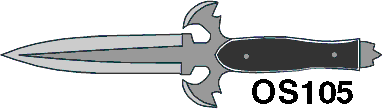
This Tradition holds that the dagger be made of steel because it is an iron alloy, double edge like the power that flows through it, and the handle be black and carve-able so that all the energies between the blade and the person can flow freely. It is a male image made of a masculine substance (iron). With the advent of eclectic Wicca and the generalization of the Pagan movement these sacred knives have taken on many different shapes and make-ups. Just about any blade seems to be usable depending on the person seeking to use it.
I tend to lean a little on the traditional side because I agree with the reasons for the traditions. I've owned my blade even before I knew why the significance of the double edge and black handle. So, this is what mine looks like.

The individual's blade is effectively a ritual phallus or a spiritual penis and as such it is the directive tool for the Will of the wielder. Of all that tools on the NeoPagan line-up, it is perhaps the most... taboo to be handled by someone else. For a witch (because we're talking about a magical implement) to hand someone else her blade is to hand someone the key to her soul, the reigns to her essential power and the ultimate weapon to be held against her. It means a lot to have a witch hand you their unsheathed dagger.  It is considered the greatest disrespect for someone to pick it up without permission (granted, if you don't know that then the owner shouldn't get his panties in a knot...).
There are differing schools on what the blade of the knife can and cannot touch and blood is the highest controversy of all. While eclectic Wiccans hold pretty fast to the idea that blood has not place in their practice, Traditional Wiccans use blood from willing persons in their magic. As a matter of fact, during a Trad Wiccan's first initiation she is pierced to let the blood flow so that she can fasten her cord. Most Kitchen Witches use a normal kitchen knife as their sacred blade and cut all sorts of things with it.  I hold, that if it is a symbol and extension of my own Will that it shouldn't cut unless threatened or in a ritual act that I might wish to use my Will to severe some bond or tie.
There are also plenty of schools that don't use a blade for one reason or another the most common two being "steel is patriarchal!" and "weapons have no place in a faith of peace."
~A. Fox